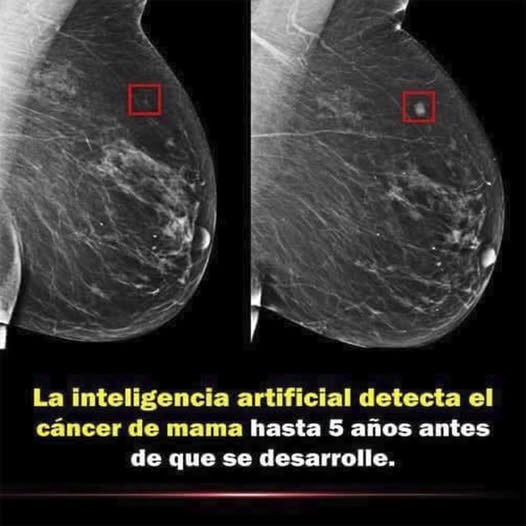
Artificial intelligence (AI) is revolutionizing the field of medicine, and one of the most significant advances has been in the early detection of breast cancer through mammograms. This disease is one of the leading causes of cancer death among women worldwide, so identifying it in its early stages is crucial to improving survival rates.
AI systems, especially those based on deep learning, are demonstrating an impressive ability to analyze mammograms with accuracy comparable to or even superior to that of experienced radiologists. These algorithms can identify subtle patterns and minute changes in breast tissue that might go unnoticed in a human evaluation, especially in very early stages of cancer.
A notable aspect of AI is its ability to learn from thousands of previously labeled images. Through this training, systems become increasingly accurate and effective in identifying anomalies, allowing for earlier detection and reducing the possibility of false positives or negatives.
Furthermore, AI can be a valuable tool in regions where access to specialists is limited. By automating the initial screening process, diagnosis can be streamlined and cases requiring immediate medical attention prioritized, significantly improving the efficiency of the healthcare system.
However, it’s important to emphasize that AI does not replace the medical professional. Its role is complementary, serving as a second pair of eyes that supports the radiologist in making more accurate and rapid clinical decisions.
In short, the integration of artificial intelligence into breast cancer detection through mammography represents a promising advance that could save thousands of lives. With its ability to detect the disease in its early stages, this technology is emerging as an essential tool in the fight against cancer.